
Someone Spent $50.000 to Rig Colombia's Election
And the version of this playbook that doesn't run on bots is the one you should actually be worried about.


I want to tell you about a guy who calls himself Basenji (https://x.com/cryptobasenji)
I watched him on Vélez por la Mañana this morning. He’s anonymous. Lives outside Colombia. Trades on Polymarket for a living. The name comes from his dog. While the rest of the country was arguing about polls for the May 31st election, this guy was reading the blockchain.
What he found is the reason I’m writing this.
A single wallet. Created for one purpose: to buy “Cepeda YES” on Polymarket. No other transactions in its entire history. Just Cepeda (Socialism), week after week, in identical chunks, at intervals so precise that no human places orders that way.
His exact words, translated:
“When you’re a trader and you want to make money, you don’t buy against your own entry price. If I have an entry at 30 cents, why would I be aggressively buying at 45 cents? It makes no sense. I’d be pushing the price against myself.”
Then Vélez asks him the question everyone watching wanted answered. How much money? Basenji answers like he’s reading the weather:
“At least $50,000. In a market with a total capitalization of $400,000.”
Twelve percent of the entire pool. From one wallet. Through automated bots. Over months.
Fifty thousand dollars buys you twelve percent of a prediction market and three months of headlines. That’s the cheapest political ad ever bought in Latin America.
The Loop Nobody Wants to Talk About
Here’s why this small operation matters more than it should:
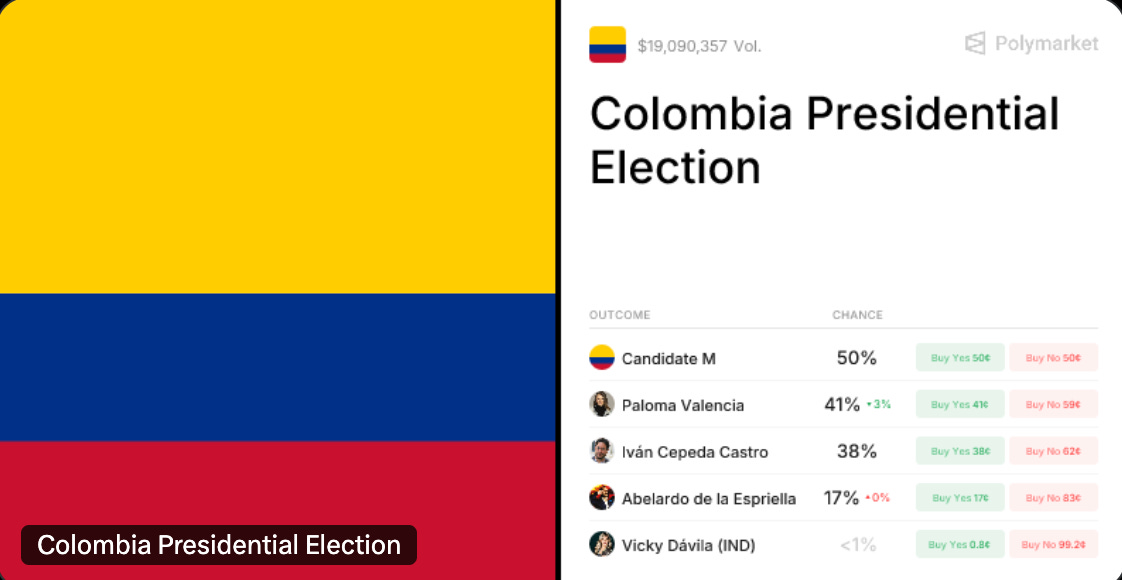
“The main problem I identified is that Colombian media uses Polymarket as a reference in their reporting, because the polling firms are doing such a bad job. And that creates an incentive for political campaigns to try to pump the market.”
Polls are broken. Media doesn’t trust them. So media starts citing Polymarket. Polymarket has $17 million in volume for our entire election (Hungary’s recent race had $60 million resolving in two days). Liquidity that thin means a few thousand dollars moves the headline number for an entire week.
Whoever controls the bot controls the front page.
Basenji also tore the polls apart. The 2025 polling law forces sampling in territories that aren’t statistically relevant, territories that conveniently favor the government’s candidate. His weighted error margin across the major firms is over 6%. He thinks Cepeda is actually sitting at 30%. The press keeps quoting 37 to 44.
That is a completely different election than the one we have been told we are watching.
His own position, on the record, with no hedge: short Cepeda. Long Paloma and Abelardo. He compares the runoff to Chile, where the right wing outsider beat the leftist who topped round one. And he drops the line that explains all of Colombian politics in one sentence:
“Only 4 percent of Colombians trust the traditional parties. The other 96 percent don’t. That’s why Abelardo took the outsider road. Outsiders work very well in Colombia.”
The country has lost faith in everything that ran it for two centuries. Whoever runs as the wrecking ball wins. Left or right doesn’t matter anymore. That’s the dynamic the polling firms can’t measure because their methodology was built for a country that no longer exists.
Where Basenji Stops, I Start
I had lunch with a friend last week. Works in a ministry. Smart guy, master’s from Externado, makes about 9 million pesos a month in a job that he basically cannot lose unless he punches his boss on camera. I asked him who he was voting for. He looked at me like I had asked him to skip a paycheck.
“Cepeda, parce. Obvio.”
He doesn’t even like Cepeda. He told me as much over the second beer. He thinks the government has been a disaster. He thinks Petro promised everything and delivered scandals. But the math on his end is simple. Petro controls the money. The state controls his next ten years of stability. There’s a gravity that pulls government workers toward whoever holds the wallet, and what they actually believe in private has nothing to do with how they vote in public.
There are over 1.25 million people on that gravity field nationally. One in every five formal workers in this country gets their paycheck from the State. That is the largest single voting bloc nobody talks about.
Outside the capital, the picture flips. Medellín, Bucaramanga, Boyacá, parts of the coast. I don’t see anyone fired up about Cepeda. I don’t see anyone defending Petro’s legacy. I see exhaustion. Scandal stacked on scandal, UNGRD still hanging in the air, ministers leaving in handcuffs. That kind of disappointment doesn’t show up in a phone poll. It shows up at the ballot box.
The Number Nobody Is Reporting
While we have been arguing about wallets and polls, the government has spent the past three weeks taking on new sovereign debt at high interest rates. Astronomical amounts. Levels no previous Colombian government has attempted, including during the Uribe security crisis.
A month before they hand over power.
Think about that. A normal president with 30 days left thinks about transition. About not leaving the country in a smoking pile. What they don’t do is borrow at punishing rates with no time to deploy the money on actual projects. There is no infrastructure that takes effect in 30 days. There is no program that justifies it.
Unless the project is just cash.
Add it to the December 2024 “economic emergency” Petro declared, the one the Constitutional Court ordered reversed, the one where the collected taxes were never returned to the people. Pattern starts to look pretty obvious.
The Maduro Lesson Nobody Learned
Look at Venezuela. Maduro lost an election. The opposition proved it with their own receipts. Edmundo González had it locked.
Maduro stole it anyway. Like he was changing the channel on a TV. He sat in the chair, served out the term, kept the cronies, kept the apparatus running for years after the world had declared him illegitimate.
Today he is in a US federal prison. Captured. Indicted. Done.
Here is the part you need to sit with: he still got away with stealing the election. He served the years he wanted to serve. He kept enriching his people. He bled the country dry on his way out. By the time the United States actually got their hands on him, the damage was permanent. Millions of Venezuelans had migrated. The opposition was scattered. The economy was a corpse.
The lesson of Maduro is not that he eventually paid. The lesson of Maduro is that paying eventually does not deter anyone.
Petro has photos with Maduro. Multiple. They were close allies for years. Petro himself has interesting things going on with US authorities that I will not speculate on in writing, but the people who follow this seriously know what I mean.
If I am Petro right now, I am studying the middle of the Maduro story. Not the ending. The middle. The years of impunity. The fact that even prison at the end did not undo any of it.
The Bot Was a Preview
Connect the dots with me.
Basenji proved that fifty thousand dollars deployed methodically was enough to swing public perception inside a four hundred thousand dollar market. One person, one bot, manipulating the number that the entire Colombian press corps then quotes as if it were a poll.
Apply the same logic with the resources of the Colombian state. With a payroll of 1.25 million public servants. With one in five formal jobs in the country flowing through Hacienda. With control over the social programs budget. With the borrowing capacity of the national treasury. With a Constitutional Court whose rulings the executive feels free to ignore.
You stop talking about price manipulation on a crypto site. You start talking about the Maduro template, run by people who watched it work in real time.
Basenji caught the small version. The bigger version doesn’t run on bots. It runs on subsidies, on contracts, on jobs for the cousins of the people with jobs, on debt taken out today and paid back by your kids in exchange for loyalty bought in April.
What I Think Happens Next
If this election were held in normal conditions, with a level field, I do not think Cepeda wins. Basenji’s data says the same thing from a completely different angle. Cepeda at 30%, no party willing to coalition with him, considered too radical by the rest of the spectrum, Chilean pattern repeats and the outsider takes it.
But normal is not the assumption I would make right now.
The next time someone shows you a poll, ask who paid for it. The next time they show you Polymarket, ask who is running the bot. And the next time somebody tells you Petro is going to politely walk away from Casa de Nariño on August 7th, ask them if they have been paying attention to Caracas.
We are about to find out which Colombia we actually live in. The one Basenji can model with data, or the one Maduro already wrote the playbook for.
If you got something from this, share it with someone who needs the same picture. And if you are not subscribed to BowTiedColombia yet, this is what I do every week. The view from inside, in your language, without the diplomatic varnish the gringo press puts on everything that happens here.
Saludos parceros,
BowtiedColombia